And trademark doesn't protect against any and all use in the same way copyright does -- only uses that might create consumer confusion with the trademark owner's uses.
Presumably, a company that has been selling grocery staples since 1935 with that logo isn't creating much confusion.
Arguably, Paraguayan Mickey has a better claim that modern do-everything Disney Mickey is infringing on its long-established trademark...
Yes, though their mascot might be? The article itself clearly states that the locals seem to associate the man-in-costume-mascot with going to Disneyland.
Unless both the US and Paraguay have ratified a 100% automatic international trademark treaty, which seems unlikely.
so the idea of a paraguayan company, in paraguay, infringing a us trademark, is legal hogwash. mickey is a disney trademark in paraguay only to the extent that the paraguayan government decides to grant it to them, a decision that should be made on the basis of, among other things, existing uses by other companies. this is a fundamental and intentional feature of trademark law in every jurisdiction i am familiar with, not a bug
— ⁂ —
to a significant extent trademark law is arbitrary in the same way traffic laws are. there's no objective reason, nothing justifiable according to some kind of natural law, that says you should drive on the left side of the road, or stop when the traffic light turns red rather than green. if everyone else is driving on the right side of the road, or stopping when their light turns green and your light turns red, that would be a better thing to do. the law in these cases is merely establishing a schelling point that allows a large society to coordinate their actions through more or less random but well-known decisions
the justification for trademark law is to protect consumers from inferior goods bearing the name of a reputable maker, but made by someone else. for this purpose it reserves particular names and logos for the exclusive use of particular makers. which particular names and logos are reserved for which particular makers is essentially arbitrary; what matters is that it be relatively consistent over time, so that consumers aren't buying good mickey-branded bread from the paraguayan mickey company one day and adulterated mickey-branded bread licensed by disney the next
(you can argue that to some extent modern trademark law is failing at this job, due to notorious cases of perfectly legal line extension fraud—such as exploding tempered-soda-lime-glass pyrex, saran-free saran wrap, pseudoephedrine-free sudafed, kaopectate without kaolin or pectin, and generic t-shirts bearing a designer's licensed brand—or the widespread phenomenon of private equity firms buying a quality brand and replacing its products with inferior replacements. but that's the justification for its existence)
https://upload.wikimedia.org/wikipedia/en/0/0d/Mickey_-_The_...
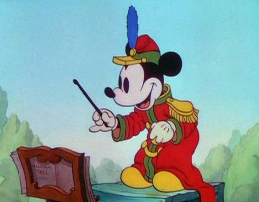
Compare to later versions, where the eyes are well defined:
https://upload.wikimedia.org/wikipedia/en/f/f6/Mickey_-_Fant...

In recent years, Disney has been using the old version from Steamboat Willie at the start of movies:
https://en.wikipedia.org/wiki/Steamboat_Willie
And even making new shorts with that style:
https://www.youtube.com/playlist?list=PLC6qIbU1olyXQe1WOKt8U...
While the art is similar, the animation is quite different (in a very bad way). They are also completely unfunny.
(* goes back to watch old hand-animated episodes of Tom&Jerry and Wile E. Coyote *)
Meanwhile the Mickey that is shown posing on top of a building in one of the photos looks like a more recent Mickey. (But I’m no Mickey expert.)
And it is important to keep that in mind.
(as your linked article from duke.edu explicitly explains)
> How do I copyright a name, title, slogan, or logo?
> Copyright does not protect names, titles, slogans, or short phrases. In some cases, these things may be protected as trademarks. Contact the U.S. Patent & Trademark Office, TrademarkAssistanceCenter@uspto.gov or see Circular 33, for further information. However, copyright protection may be available for logo artwork that contains sufficient authorship. In some circumstances, an artistic logo may also be protected as a trademark.
see also https://www.quisenberrylaw.com/ip-discovery-blog/who-owns-th...
it seems clear that the paraguayan mickey company is the legitimate owner of the paraguayan trademark
The business in question literally has a mouse, named Mickey, that looks a lot like the trademark of Disney, on their packaging, their buildings, and their advertisements. They are literally using Disney's trademark.
The article is about trademark, not copyright.
https://web.law.duke.edu/cspd/mickey/