- rapjr9How does many worlds justify the doubling of energy with each quantum split? Probability can double all the energy in existence for every quantum fluctuation? Is energy conserved between realities? If not, that makes reality a very strange place. We could potentially use that to create infinite energy, infinite people, planets we could grab, if we could move stuff between worlds.
- Not everyone sees color exactly the same way, for example some people can see a little into the IR and UV. While the pilots may not be colorblind, the people who repair the displays might be. Situations can also make pilots colorblind, like strong glare coming through a window. It's better to have an unambiguous display that is easy to interpret rather than to rely on something that can be subjective like color. People can only reliably identify a few distinct colors, so if you have 300 kinds of planes and missiles to identify using shades of red and purple doesn't work so well. An ID number next to an icon can handle thousands of kinds of entities. People can tell color #F0479E is different then #F04750 when comparing them side by side, but they probably can't tell you what the exact name of each shade is, and at a glance they might think they are both the same color. So it's not so much colorblindness as it is the limits of human perception. What I call Hunter Green and English Racing Green might look like the same color to you.
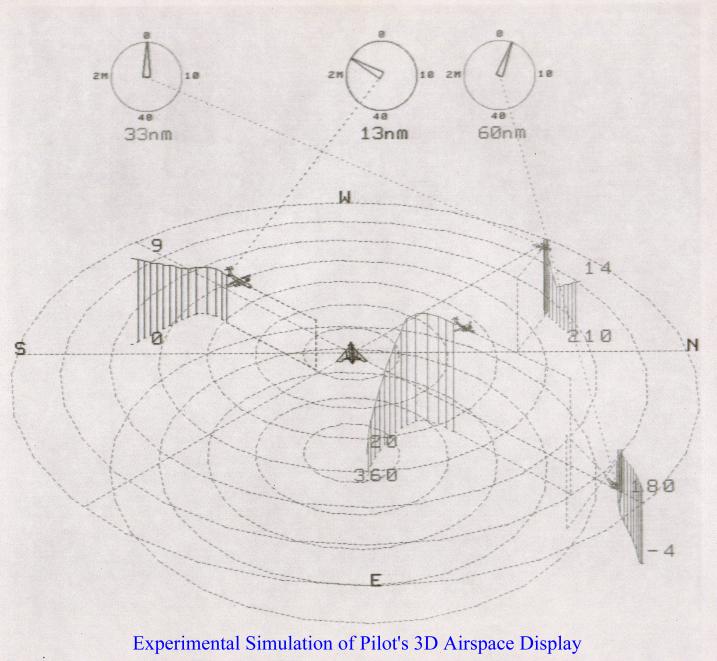
- Yes, it was supposed to be an alternative graphic for a cockpit radar display in a jet fighter. The goal for any such display is to convey maximum information at a glance. I got feedback from a fighter pilot who said he wouldn't use it. Most people don't think in 3D, they think in 2D. Pilots have to think in 3D to some extent, but in a battle a fighter pilot wants to know what they immediately need to pay attention to, which is usually something heading directly at them (another jet or missile) and they mostly want to know the direction it is coming from, not so much what its altitude is. I made the path histories fade out so they didn't get too long and clutter the screen. The vertical bars were calibrated to indicate a specific distance so they also gave an idea of velocity. It would be possible to add/remove things from the display based on some automatic assessments of priority (i.e., remove everything not headed at the pilot, though having things appear and disappear can be confusing also). The aircraft icons were actual wireframe models representing the type of the aircraft, but had to be oversize to see them, which added some confusion also. The pilot found a fixed size icon with a few numbers next to it and highlighting for approaching/receding much more useful. Took me a long time to digitize them with just a ruler. While such a display may not have a technical use, it might be useful in advertising, showing travelers at an airport what is going on around the airport at the moment for example.
- Cool, I tried something similar 30 years ago working for a military contractor:
http://zoom.interoscitor.com/PetersonEnterprises/Consulting/...
I was asked to come up with a 3D display of the airspace around an aircraft for the pilot to use and which could replace the 2D displays used then. People were impressed, but decided it was impractical for a variety of reasons. You can't really tell where the aircraft are relative to each other and the ground without rotating the display (which means the pilot loses their orientation), and there are no altitude indicators and it's difficult to tell where each aircraft is relative to the others. (Which is why I added the vertical lines and ground tracks.) Also things get visually messy when several aircraft are close together, even if you use different colors (which doesn't work for the colorblind). For example, could you use this display to tell if a collision is imminent near ground level in proximity to an airport? The display does give you a high level sense of what is going on in the airspace; it may not have enough details to be of practical use to pilots and air traffic controllers. I'd suggest consulting with them to get feedback. Maybe this would be practical as a VR display? How did they solve this in the F-35 helmet display?
- What is perhaps more important is how this transition will be managed. Are the old methods just being halted and all projects halted and the new methods will take over whenever they start producing products? Switching horses midstream could end up destroying both old and new acquisitions without a good plan. This seems like something the Trump administration has continually failed at, they break things first, then try to figure out what to replace it with while chaos ensues. Possibly they will have to fund much of the existing plans while simultaneously funding the ramp up of the new plan, perhaps doubling the cost of acquisition for a while. Even if the new plan is faster overall, there may still be a five year delay before products start to appear from factories.
- So next we should bring back the air raid sirens and bomb shelters.
- These are their alternatives:
What neither Big Tech nor Big Media will say is that stronger antitrust rules and enforcement would be a much better solution. What’s more, looking beyond copyright future-proofs the protections. Stronger environmental protections, comprehensive privacy laws, worker protections, and media literacy will create an ecosystem where we will have defenses against any new technology that might cause harm in those areas, not just generative AI.
- They don't seem to have considered fungus spores as PM2.5 either. Seems like a single spore could cause more damage than many carbon particles.
- This group has had some success turning machine learning algorithms into low power analog chips:
https://sites.dartmouth.edu/odame/
Not the same as general purpose training type computations though.
- If this is being recognized as a systemic problem should not the government step in and regulate? Why do they have to wait until after a crash to do anything? Just a statement that there will be no bailout could moderate behavior.
- Can't anyone use AI to surveil social media, even ordinary citizens? It seems like it would be easy to surveil ICE, the police, immigrants, all politicians, the military, businesses, government, individuals, groups, anyone and anything anyone has an interest in. Is the future everyone surveilling everyone else? There used to be web services that let you set up "standing queries" for anything you were interested in. In a sense chatbots already contain a historical record of the internet in compressed format and allow anyone to do historical queries on anything, limited only to what has been accessible on the internet. "Googling someone" is becoming "ChatGPTing someone". People felt Googling someone was somewhat rude and parents warned their children to limit what they posted in case future employers looked them up. Same for anyone employed, they are learning to be careful what they post in case their employers see it. Seems like free speech is being suppressed because it can be used against you by various people and groups already. This may help explain why the web has become less interesting and anonymous posting is ubiquitous.
- Fortunately the solution is easy, cloudbusters:
https://en.wikipedia.org/wiki/Cloudbuster
Basically a metal rod/pipe with a good earth ground pointed at the sky. How conductive are trees? Maybe trees already act as cloudbusters, so we should plant more trees! Someone should apply for an NIH grant to try this. Don't know if I'm being sarcastic, it might actually have health benefits, there doesn't seem to have been much independent research.
- Rare earths are not rare on Earth, but production of rare earth metals is rare and difficult and almost exclusively done by China. There are two other factors that make this announcement important though. One is the use of the foreign direct product rule, which means China is requiring all use of rare earths produced by China to be tracked and require approval, and all military applications are not going to be approved (why would China arm it's competitors?) The other factor is that while things like F-35's may only use a few hundred pounds of rare earths each and there are not many of them, things like smart bombs and semiconductors need rare earths and there are a LOT of those. If China can truly cut the US from China's production, it's likely going to greatly reduce the US's current attempts to scale up both weapons production and the more advanced semiconductors (like GPU's for AI) until the US can get alternate sources. It will take 5-10 years to build alternate sources (some small pilot projects are near completion, but scaling up will take a while), so during that time the US could be short on weapons and compute power. The US military has done some stock piling of rare earths, but it's a fairly small stockpile. So worst case is no weapons or AI for the US for some time.
There will also be consumer effects. EV's, drones, phones, TV's, RC cars, and more all use rare earths or rare earth magnets. Because rare earths were cheap before, most quality electric motors now use them. China can now cut off those uses also if they want to.
How effectively China can halt sales to the US is debatable. The CIA could start a toy manufacturer front company and buy rare earth magnets for example. China may eventually find out and cut them off, but then the CIA can just start a new front company. Buying from European or Asian companies as intermediaries may be difficult to enforce. If a war started over Taiwan, China could just cut off all shipments to the world. So there is perhaps a five year window here where China can exercise power via rare earths. Beyond that alternate sources will likely be in place.
So one thing China is "saying" here is that if the US is going to cut China off from advanced computer chips, China is going to make it impossible to make those chips so the US won't have them either. This could be enough to bring a sudden halt to US AI investment. It would definitely introduce a big new uncertainty.
- Indeed. So what is missing from the list? Perhaps emulsifiers?
- If these strikes really are hitting drug gangs, I would expect the gangs to strike back, just as they do when they attack each other. They already have people in the USA, and they would have no problems with attacking civilians or politicians, they already do that. Maybe that's part of the plan behind using the military, create incidents in the US in order to impose martial law? On the other hand the War On Drugs has been around for a long time and I don't know of any attacks on the US because of it (except for the drugs themselves). Maybe the use of military force was what the drug gangs were afraid of, but now that restraint has been removed. Even if the real purpose of the strikes is regime change and taking over the oil industry, there may be side affects for US citizens due to pulling the gangs into it. Difficult to tell where this goes. There must be ongoing legal debates also, this seems clearly outside of international law.
- Isn't the training most of the cost? In which case the current models could have a very long lifetime even if new models are never trained again. They'll go gradually out of date, but for many purposes will still be useful. If they can pull new info from the web they may stay relevant for decades. It's only if running the chatbots is not cost effective that everything halts and my understanding is that the cost of that is lower relatively. Even now, older models are still being used. Also, performance optimizations seem likely to soon reduce the need for data center build out and reduce costs. Seems too soon to say where this is all going. Who even knows if the GPU chips will improve dramatically or if something else (more AI optimized processor architectures) will replace them? It's true that right now it looks like a bubble, but the future is still very much in flux, and the value of the models already created may not disappear overnight.
- One potential application might be fighting wildfires. Seems like it would be really useful if one firefighter could remotely monitor a dozen autonomous bulldozers that were given general instructions. Would have to acquire a different training data set I'd guess, but the same approach seems applicable, get the data from teleoperated bulldozers used to fight fires. Getting the bulldozers into the right area would require some transport, like a truck or heavy lift helicopter, though maybe mini bulldozers would also work.
You might be interested in the work of Peter Corke also, he's automated horizontal mine shaft loaders and huge drag line shovels in his research:
https://www.youtube.com/watch?v=YUb9_Ysd2Hw
I think he used a different approach than you do, using visual servoing to get feedback and data from a camera. Maybe there's some value in combining both approaches, learn to control a machine from an operator, and also keep track of what is being moved with a camera to add another layer of control.
- About 20 years ago the CS community was getting excited about optical memory. It promised to be huge, must faster than static RAM, and hold it's state. Tied directly to the CPU as a very large cache+RAM replacement it would have revolutionized computing. There were other advantages besides speed. One was that you could just pause the CPU, put the computer to sleep, then wake it up later and everything was already in RAM and computation would continue where it left off. Instant boot. Running apps would be instant, they were already in RAM and could be run in place. Prototypes existed but optical memory never happened commercially. Not sure I remember why, maybe couldn't scale, or manufacturing problems. There was also the problem that code is never perfect, so what to do when something stored became corrupted? Without a boot phase there would be no integrity checks.
- I worked with an SGI 2400T workstation and it came with a 4:3 aspect high resolution monitor (4K I think, different from today's 4K). Later workstations probably had wider screens. However even that old machine could display to a wide variety of screen sizes. I connected ours to an NTSC projector and they were often used for rendering movie computer graphics (though rendering doesn't depend on the display size). If I remember correctly the pixels were square by default, but there was a lot of control over rendering and display. NTSC at that time wasn't even a very firm standard, lots of companies implemented it differently and hi-res displays tended to be custom with no standards at all (used for air traffic control for example).
- That's actually the ROM Kernel Reference Manual (RKRM), not the Hardware Reference Manual. The RKRM was another great reference manual for the Amiga. Quoting from the preface:
The Amiga operating system is composed of libraries, devices and also resources, all of which provide APIs and data structures for shell commands and Workbench tools to make use of. The foundations on which everything else in the operating system rests are the Multitasking Executive (“exec.library”) and AmigaDOS (“dos.library”).
dos.library itself depends upon exec.library, it is “just” another operating system component after all. You might have expected that AmigaDOS plays a much greater part in the operating system, but the Amiga operating system is not constructed around its DOS component. Almost every Amiga program makes use of exec.library, such as for accessing libraries and devices, but not every Amiga program has need of what dos.library provides. Of course, also libraries and devices can make use of dos.library, such as by opening files on the context of the caller of a library function. Great care must be taken to verify that the caller is indeed a process.
AmigaDOS encompasses dos.library, the CON-Handler, the RAM disk implemented by the RAM- Handler, the default file system and the command line Shell, as well as the shell commands on disk. These components came, mostly, from TRIPOS (Trivially portable operating system) [11] where they were part of a much larger networked multitasking operating system . As one of the last pieces to fall into place in 1985, the components were specially adapted for the Amiga and were not written by the original Amiga and Commodore developers. Both the Amiga operating system and TRIPOS had in common that they were built around non-copying message passing in a shared memory space, which enabled AmigaDOS to work “hand in glove” with the architecture and the means provided by exec.library.