3
points
paulsmith
Joined 1,670 karma
http://pauladamsmith.com/
- paulsmith parentI'm glad you shared this because, in my head this Dr. Nick quote is so canonical it must be from the original golden 8 seasons, so it's nice to be reminded there are occasionally good things after! ;^)
- You can wrap the navigation event in document.startViewTransition() and get something basic out of the box:
- For example, health care plans in the US are county-specific with regard to premiums, co-pays, etc. (based on demographics). Allowing someone to type in their ZIP Code to get started can be a better user experience than having them pick their county.
- This is a fact of ZIP Codes that a lot of people stumble one. I've worked on GIS/mapping projects in the past where stakeholders wanted or assumed ZIP Codes to be polygons.
Another complexity that surprises folks is you can't guarantee a one-to-many state-to-ZIP Code relationship. There are several (I forgot offhand how many, I used to have them memorized) that span across state boundaries.
- Similar timing, I had a high school internship at the National Cancer Institute at Ft. Detrick, MD in 1994-95, and the lab down the hall had some SGI iron and a glove (I don't remember what the glove hardware was, if it was SGI or 3rd-party or custom) for manipulating 3D renders of folded proteins. Incredible stuff, same "in the future" feeling.
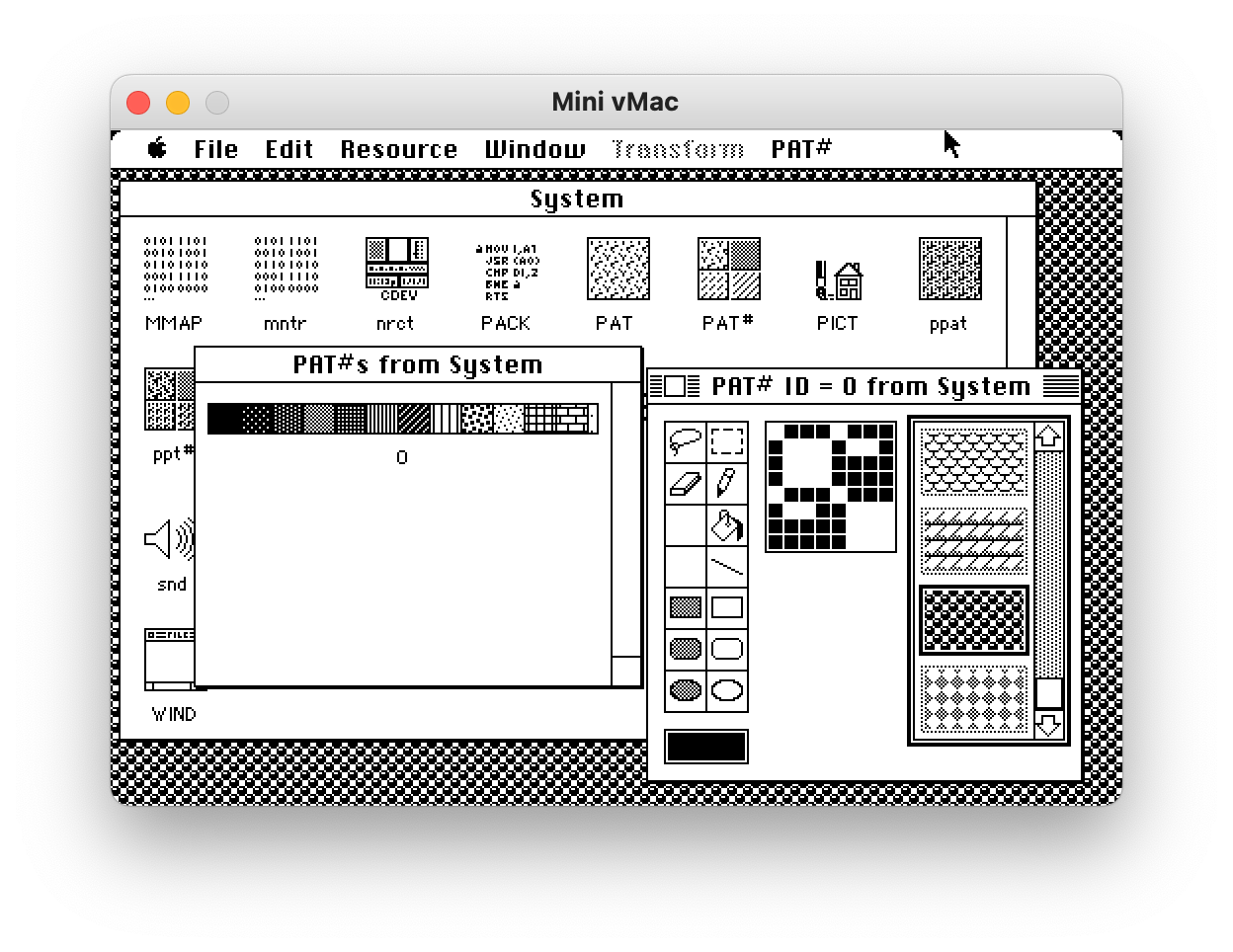
- It's a great point, and I did consider it, the trouble is, how do you get the pattern resource data out of ResEdit running in the emulator and onto the modern machine? And ResEdit doesn't seem to run in any kind of compatibility mode on modern Macs anymore either.
It's too bad because ResEdit is an amazing program, and even has a surprisingly full-featured graphical editor, including for those patterns, with a live preview mode:
https://raw.githubusercontent.com/paulsmith/classic-mac-patt...
- Oh, good idea. I'll add them to the showcase site shortly. https://paulsmith.github.io/classic-mac-patterns/
- Huh, sure enough: https://www.lyonlabs.org/commodore/onrequest/geos/lobster-64...
- > say model returns the probability of the token "cat" on the second position as p_2("cat") = 0.3, while p_2("dog") = 0.6. We may want to replace "cat" with dog, and use it in the subsequent iterations.
Might one tradeoff of speed/quality be a tree "search" for better outcomes by branching on logit choices? If a diffusion model is so much faster overall than AR, then I might not mind that I hunt or backtrack for the best probabilities overall.
- Yep, and S1E7: https://moviemaps.org/episodes/9c8
I was reading this post and thinking, huh, this would be a good set for a Coruscant shot in Andor, and sure enough ...
- 1 point
- For fans of this there's another '70s-era LP similarly inspired by the novel: Bernard Szajner's "Visions of Dune" from 1979. It's proggy, synthy, psychedelic, and just a weird fun listen.
- My whole life I've been doing stereograms by diverging, but I couldn't get the three images in the post (the pairs would get closer but never fully overlap), so I tried crossing based on your comment. It was way easier than diverging (obviously, since I couldn't do it otherwise), but it took me a few tries, because I think it's actually /too/ easy to cross your eyes compared to diverging - I was way overshooting when I crossed my eyes. The trick was to notice this, and then control the un-crossing until they lined up.
- Hearing the evolutionary anthropologist Herman Pontzer talk about this was really eye-opening for me:
https://www.msnbc.com/msnbc-podcast/examining-energy-evoluti...
"[Y]ou can think about all these processes as competing for calories over the course of the day. And normally, low priority things like having a really high inflammation response or having a high stress response, those get tamped down in a highly active population like we've all evolved in. But now, you move to these weird zoos that we've built ourselves, where you don't have to be active, food's available all over the place, energy supply is really easy. And now, these low priority activities which used to probably only happen very occasionally in the past, in the deep past, now are happening all the time, chronically, at these super high levels, and it's actually really bad for you."
- > To see why, consider an important metric that tallies up how much room a system will need to store data. You start with the base of the number system, which is called the radix, and multiply it by the number of digits needed to represent some large number in that radix. For example, the number 100,000 in base 10 requires six digits. Its “radix economy” is therefore 10 × 6 = 60. In base 2, the same number requires 17 digits, so its radix economy is 2 × 17 = 34. And in base 3, it requires 11 digits, so its radix economy is 3 × 11 = 33. For large numbers, base 3 has a lower radix economy than any other integer base.
I thought that was interesting so I made (well, Claude 3.5 Sonnet made) a little visualization, plotting the radix efficiency of different bases against a range of numbers:
https://paulsmith.github.io/radix-efficiency/radix_effciency...
- DevOps predated microservices by a good bit. And DevOps was meant to reduce operational complexity, because the people who best knew how to run the software were the ones who made it. (DevOps also predated commoditization of the infra layer, we didn't know about Docker or k8s yet.) And they could use the direct experiential feedback loop of driving the car they had built to plow understanding right back into the next iteration. Or ideally anyway.