- lqetWe have come a long way down from ads like https://www.youtube.com/watch?v=1VM2eLhvsSM
- > Today, [young people] like to spend time with the smartphone; they even take it to bed when they go to sleep.
Recently my parents (in their mid-60ies) were visiting us. At some point I realized that both of them had been quietly sitting at our dinner table for over on hour, eyes glued on their smartphones. They are massively addicted. I have noticed that they get nervous as soon as the smartphone is out of reach, or even in silent mode. They mostly talk to friends via Whatsapp and are in constant fear that they miss out on something or that these friends (which also seem to spend most of their days on Whatsapp) will be offended if they don't reply within 5 minutes to the latest Whatsapp trivia. It is quite a struggle to even get them to turn off their phones when we are having dinner. The Whatsapp messages just keep coming in. My wife recently learned that her mother mostly spends her evenings with posting photos of her life on social media, and broke off contact with her brothers for a few days because they failed to quickly and enthusiastically react to some photos she posted on a family Whatsapp group.
But I guess for Anna Possi, our parents are "young people" and could be her grandchildren...
- I you mow them after they have developed seeds, you are mowing them too late.
- Weeds on the lawn: just use a lawnmower each week, the grass will usually handle being cut on a weekly basis much better than any weed.
Weeds between tiles / slabs or on gravel: just pour boiling water over them. The weeds will become mushy and die within 1-2 days. Repeat every 6 weeks during summer.
Source: we bought a house with a garden full of goutweed [0], which I consider the final boss of any garden owner, and which we have in control now through regular mowing / hot water. Goutweed will just laugh at any herbicide you throw at it, and regrow from its underground rhizomes. I also doesn't seem to require sun, because I have seen plants grow to a height of 10cm completely underground. The joke in my family is that it could grow on foreign planets. As Wikipedia dryly puts it: "Once established, goutweed is difficult to eradicate."
- It may go further than that:
> Fever is used by organisms as diverse as fish, amphibians, reptiles and mammals (see for reference Basu and Srivastava, 2003). Since fever is metabolically expensive, it must provide substantial advantage to the host. Surprisingly little is known about immunological effects mediated by fever, a lack of understanding that might be attributable in part to the common ignorance in clinical practice with respect to benefits fever might provide. Post-operative infections can be prolong survival: patients developing empyema after lung cancer surgery have improved 5-year survival (50% (n = 18) vs 22% (n = 411)) (Ruckdeschel et al, 1972). In this light, it seems unfortunate that fever is usually suppressed in hospital routine.
> The phenomenon of spontaneous regression and remission from cancer has been observed by many physicians and was described in hundreds of publications. However, suggestive clues on cause or trigger are sparse and not substantiated by much experimental evidence. [...] At least in a larger fraction of cases a hefty feverish infection is linked with spontaneous regression in time and is investigated as putative trigger.
> Professor Busch in 1868 introduced the infection of cancer patients by purpose as a novel strategy to treat cancer. He achieved a dramatic regression with his first patient using live Streptococcus pyogenes bacteria, the pathogen leading to erysipelas, published in the German Journal ‘Berliner Klinische Wochenschrift’ (Busch, 1868). Beginning in 1891, this strategy was exploited by Coley, who had some reading knowledge of German (Hall, 1998). Coley systematically applied Streptococcus pyogenes extracts – later called ‘Coley’s toxin’ – to cancer patients and achieved a remarkable rate of regressions. A retrospective compilation of cases considered inoperable at the time of treatment between 1891 and 1936, which was conducted by Wiemann and Starnes (1994, Table 2), determined a remission rate of 64% (108/170) and a 5-year survival rate of larger than 44%. Coley used to inject his extract once or twice a week over a period ranging from a few weeks to several months. His method became quite famous and was tested on hundreds of patients by him and contemporary physicians, but overshadowed by the development of X-ray treatment which was regarded to be much more powerful and of broader applicability.
> Since cancer is usually a slowly progressing disease with occasionally long periods of dormancy, putative beneficial fever effects should also precipitate as preventive efficacy. This can indeed be found. In a cohort of 603 melanoma patients compared to 627 population controls, an inverse correlation was found between melanoma risk and number of recorded infections on the one hand and between melanoma risk and fever height on the other hand, leading to a combined reduction of melanoma risk of about 40% for people with a history of three or more infections with high fever above 38.51C (Koelmel et al, 1999). Mastrangelo et al (1998) report a striking inverse correlation between the number of infections and mortality from tumours in Italy in the period 1890 –1960: every 2% reduction in the number of infectious diseases was followed by a 2% increase in tumours about 10 years later.
- Strongly agree. I was involved with several CS lectures in the past ~10 years that did not require a final exam, and we always did a 1:1 session between student and tutor in which the tutor asked the student detailed questions about their past exercise sheet solutions. Over the years, I estimate that I conducted about 100 of such 1:1s. It was always obvious when the students did not write the code themselves. They couldn't really explain their design process, they didn't encounter the edge cases themselves during testing, and you couldn't discuss possible improvements with them.
- > Most of what schools teach is either useless or toxic
You must have a pretty broad definition of useless / toxic if you think that reading, writing and basic math, but also geometry, calculus, linear algebra, probability theory, foreign languages, a broad overview of history, and basic competency in physics / electronics fall under these categories.
Sure, I learned a lot in school that turned out to be pretty useless for me (chemistry, basically anything I learned in PE, french), but I did not know that at the time and I am still grateful that I was being exposed to these topics. Some of my classmates developed successful careers from these early exposures.
- Click on "settings", and be surprised what "accept all" means.
Note: each of the tabs on the left has their own "vendors" you may grant access. In total, there are over 800 toggle switches.
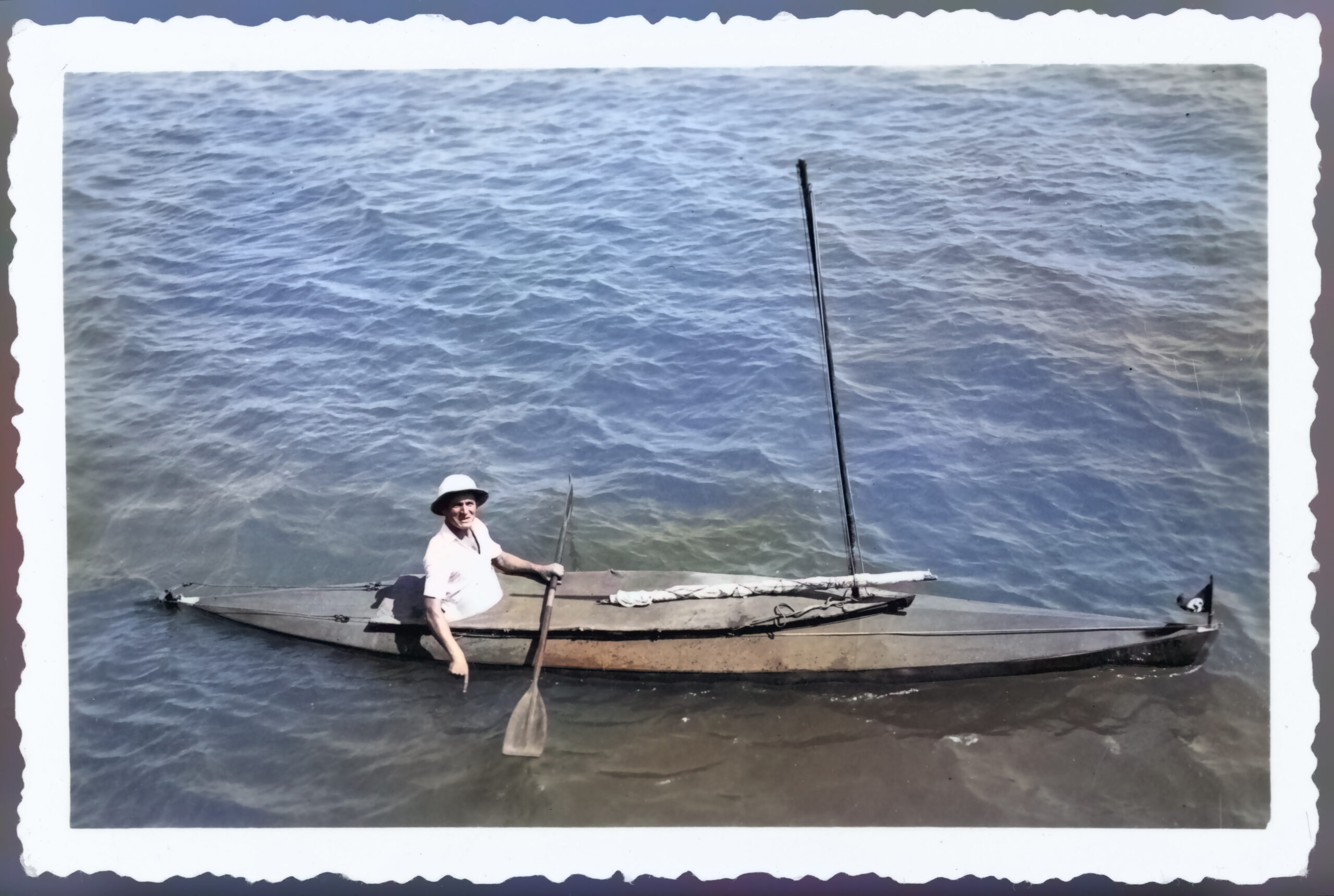
- > Exactly a year after the attack, I left Saumlaki in a new boat, crossed to the Kei islands, and then faced the longest lap of island-hopping to New Guinea.
Indeed, looking at the map of his route, the longest distance he had to actually travel on open sea seems to be around 120 km from the Kei islands to Papua New Guinea [0], which is (at least for me) completely counter-intuitive for a Kayak voyage from Ulm to Australia.
- It isn't, I posted in the wrong comments section, sorry for that!
- One of his boats (he used four): https://upload.wikimedia.org/wikipedia/commons/thumb/5/56/St...
His route: https://upload.wikimedia.org/wikipedia/commons/6/67/Speck-ma...
Photograph of him at the Timor coast: https://cdn.mopo.de/uploads/sites/4/2024/04/farbe-oskar-spec...
This seems to be a photograph taken after his arrest: https://lovedaylives.com/app/uploads/2021/03/SPECK-2.jpg
According to the German Wikipedia, he had a small electrical company which went bankrupt during the Great Depression. His original plan was to "only" paddle to Cyprus to work in a copper mine.
- Slightly related: https://xkcd.com/2892/
- Philosophical problems regarding the fundamental nature of reality aside, this short clip is relevant to your question:
> https://www.youtube.com/watch?v=tCUK2zRTcOc
Translated transcript:
Physics is a "Real Science". It deals with reality. Math is a structural science. It deals with the structure of thinking. These structures do not have to exist. They can exist, but they don't have to. That's a fundamental difference. The translation of mathematical concepts to reality is highly critical, I would say. You cannot just translate it directly, because this leads to such strange questions like "what would happen if we take the law of gravitation by old Newton and let r^2 go to zero?". Well, you can't! Because Heisenberg is standing down there. - Great post. I have been intrigued by the life in Antarctica (especially the people living this life) ever since watching Herzog's Encounters at the End of the World. This place seems to attract a fascinating variety of characters, many of which seem to have sprung from a 19th-century adventure novel (or even from one of the expeditions of the Heroic Age).
- For those unfamiliar with this "rental tax": If you own a house in Switzerland, the tax office assumes that you are your own landlord and rent your house to yourself. It estimates the fictitious rent you charge yourself, and you have to pay income tax on it. The Swiss German name for this estimated rent is "Eigenmietwert" ("self-rental value") and this is what will now be abolished.
What makes this strange tax even more absurd: as you are your own landlord, your property interest rate becomes a business expense of your hypothetical rental company. So you can deduct your property interest from this income tax on the fictitious rent you pay yourself.
In effect, it is unattractive to fully repay your mortgage (you just leave enough debt to avoid the income tax), and Switzerland has the highest household debt in the world. By a large margin [0].
[0] https://en.wikipedia.org/wiki/List_of_countries_by_household...
- > People spend hundreds of dollars and many hours sharpening kitchen knives
I am ashamed to admit it, but I have been happily using this 5,99 EUR IKEA knife sharpener for nearly 10 years know:
https://www.ikea.com/de/en/p/aspekt-knife-sharpener-black-57...
I use it 1-2 times a month for 30 seconds on the 2 knives I use in the kitchen. They pass the paper test. Previously, I used the bottom of a coffee mug.
That being said, thinks like [0] do exist and people seem to buy them.
- arte had a very good documentary about Gaudí some time ago, which also analyzed the engineering aspects of his earlier buildings in details. Very interesting, but I was unfortunately only able to find a German version on YouTube: https://www.youtube.com/watch?v=eH4YUeZSsTA
- Every winter since I was a kid, I get Keratosis pilaris [0] on my inner upper arms, which is a bit of a nuisance. After the first day of spring sun in a T-Shirt, it disappears completely within days.