- Let's not mince words:
- The decentralization of markets (criticized by some, though I'm not among them) is often condemned because it can lead to elements of economic power centralization. Critics argue that it makes people dependent on tools and technologies controlled by a few, and driven by profit.
- The decentralization proposed in the technological field is closer to anarchist ideals and suggests a kind of decentralization implemented by individual people and groups on a voluntary and mutualistic basis.
I don't believe the latter can truly benefit humanity because I don't think we are that evolved. Individuals primarily seek their own personal gain and are often so uninformed as to not understand that this personal benefit is only achievable with the benefit of the community. I believe that the market (controlled and monitored by nations and supranational entities) functions better because it is an imperfect model that, by leveraging people's selfishness, compels them to collaborate and communicate with each other.
- Thank you. It seems like you have a clear path for this transition. Do you have any reading suggestions that explain this transition?
- I understand your point of view, but I'm not sure we're that far ahead in progress. It seems very solar punk science fiction if we're talking about the near future. If we're talking about a more distant future, then I can still hope for it.
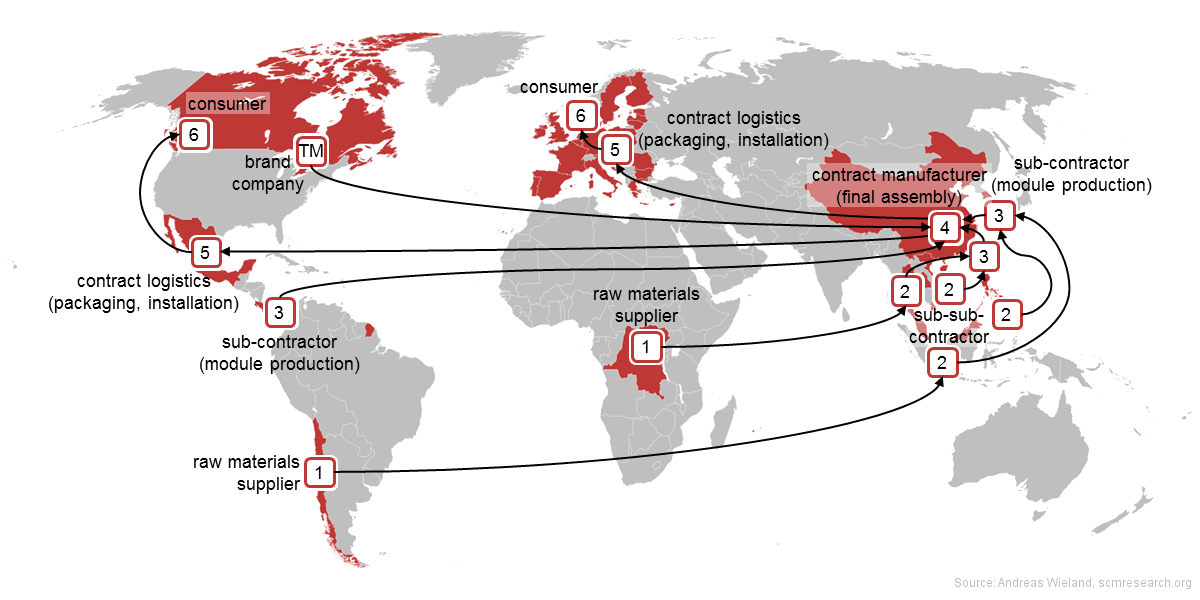
- We are a planet of 8 billion people. Through what other supply model could we ensure the production of computers and technology for everyone (or even just for some) if not the market? Here I found an infographic that shows how the supply chain for the production of a PC works:
https://scmresearch.org/wp-content/uploads/2018/09/supply_ch...
This also applies to science. The Covid pandemic is almost certainly a result of global warming caused by human activities, but the vaccine for Covid was found thanks to a shared effort of humanity, encouraged by both government policies and, above all, the profit of pharmaceutical companies.
I am well aware of all the flaws of capitalism, but I can't understand how we can have an "information age" without a market. We can try to reduce our impact, learn to decentralize, learn to fix things that break (all things I personally do), but I can't envision a decentralized technological and scientific world that wouldn't set us back 300 years.
- Hello,
Thank you for the link you've shared. I read it with great interest. While I can conceive that the aforementioned areas might survive in a post-industrial civilization, it is unclear to me how the technology that 100rabbits is researching could do the same. They might use Raspberry Pis or old PCs donated by others, but:
- these are impossible to manufacture without industries, and they are limited in number
- the only means of communication they're using to share their work, the Internet, inherently requires an industrial society to exist
This seems somewhat akin to the naive reaction to the financial crises we experienced a few years ago: "Oh dear, banks and finance can be evil, let's decentralize with Bitcoin."
I believe that we cannot address the problems that technology has brought us (nuclear weapons, global warming) without resorting once again to technology and science. This technology and science must necessarily be funded by the market.
We can afford to imagine new systems and models because we have significantly more time than our predecessors. We have more time than our ancestors because we are highly specialized, and we exchange this specialization on a local and international level for services, goods, and raw materials.
In the scenario you propose, would we have the time to search for raw materials, study to understand how to process them, create the objects and tools we need, and simultaneously dedicate ourselves to other things (i.e.: while we are doing all of this, we need to attend to children, family, and the fulfillment of basic needs such as food, leisure, sleep, illness, etc.)
In my opinion, it isn't possible. I would more readily understand forms of anarcho-primitivism in which people decide to return to nature and primitive values, either forcibly (which might be feasible) or voluntarily (which seems highly unlikely). At least these do not violate the spatial-temporal limits in which we live :)
Friend, I love being as independent as possible, fixing things by myself and maintaining a garden at home, but I'm aware that it's just a hobby. It's a hobby I can indulge in because for other needs, there are others in the market to lend a hand. If I were to have a toothache tomorrow or if my glasses were to break, in a fully decentralized model like 100rabbits, I'd be in trouble :) Or perhaps, I'm still missing some pieces of the puzzle they propose.