gen2brain
Joined 78 karma
- gen2brain parentThis is an older thinkpad I am using, 4 cores, 16G of ram. LLVM is now dependency you cannot get rid of. That is painfull, but in the morning, after several hours it is usually done. Rust is LLVM plus I am not sure what, really painfull. And Gentoo also forces many different arches and flags for some reason, use flags are masked, you cannot easily disable them.
- Error handling in Go is actually very nice. You do not have unhandled errors, not possible unless you really want to not handle the error. Now I even use it similar in Python, amazing how many errors I did not handle at all. But what got me into using Go is that there is no libc dependency, just system calls, static binary, that is just amazing. I can compile Go compiler in like few minutes. Rust I cannot even compile after 24h, I use rust-bin in Gentoo,luckily that exists.
- Window positioning? You cannot position the window, you cannot send a hint, nothing? So my pop-up with GTK4 will randomly be placed somewhere, anywhere, without any control. OK, GTK4 went further and also removed popups without the parent, so you hack that with an invisible anchor window and then write platform-specific code for sane platforms that CAN, of course, move the window. And let's not talk about window icons that you have to put somewhere on the file system?
- IUP has custom-drawn controls for tables and cells (additional controls), and it uses another CD (canvas draw) library for that, not internal IUP Draw functions. I also started rewriting that to use the core IUP drawing functions instead. I also added a few more drawing functions, for rounded rectangles, bezier curves, and gradients. But ALL drivers, including Motif, have native table controls, so I really want to add one. Edit: Also, the GLcanvas control now has an EGL driver, with native Wayland support for GTK3, GTK4, and Qt6 (needs private headers). I modernized a bit of everything, added support for APPID, DARKMODE, etc. Linux uses xdg-open rather than hardcoding browsers. Win32 driver is not using the Internet Explorer web control but the WebView2 with custom loader, on GTK, you do not have to worry about the WebKitGTK, it will find the correct library with dlopen, etc, etc. But, there is still a lot to do.
- I am working on the UI library and bindings for Go. Still not finished, but currently, the same app can be compiled for Win32, Cocoa, GTK2, GTK3, GTK4, Qt5, Qt6, and Motif. There is a web browser control, a GL canvas, and a regular canvas. I still work on the native table control, though.
- I do not give up on my openbox. I use it with LxQt. Now there is a Labwc, similar to openbox. It uses its XML spec for config and is similar. But I am still on X until all issues are resolved. Can I use openbox on KDE now? It used to be possible, I can choose WM in LxQt. Back then every WM had a --replace option.
- Protocol, maybe, and there was no "Wayland"; there was Gnome and KDE. I was only recently able to try Labwc with LxQt, and I occasionally try to see if there are some improvements because it is not usable currently. The biggest issue is that every implementation is different; there is not even a shared common library. If Xorg developers are now working exclusively on Wayland, when are they going to start programming?
- JPEG can be YCbCr, RGB or even CMYK (usually from Photoshop or similar software). There can also be unusual subsample ratios for YCbCr, such as 4:2:1. I created some WASM Go bindings for jpegli, and I recall that such images cannot be represented in Go; therefore, for these images, I force RGBA output.
Also, XYB is an option; I use the adaptive quantisation option from jpegli (with progressive level 2) to get smaller files. I never bothered with XYB, as it looked complicated.
- Nice, thanks. All the other Qt bindings seem abandoned. https://github.com/kitech/qt.go is interesting though, it uses a huge wrapper, and then FFI calls. Now we can use libffi with purego (there is already a library) so in theory such a method can be used for CGo-free Qt bindings.
- Check https://github.com/bitfield/script for shell-like scripts in Go.
- There is still an ALSA OSS emulation in the kernel, probably distros do not enable it but I have had it enabled for years. All it needs is some ioctl system calls, which does everything for me internally. ALSA with just system calls and without libalsa can work for some cards but it would be hit and miss. I like that I can use OSS in Go without C/CGo, i.e. https://github.com/gen2brain/oss.
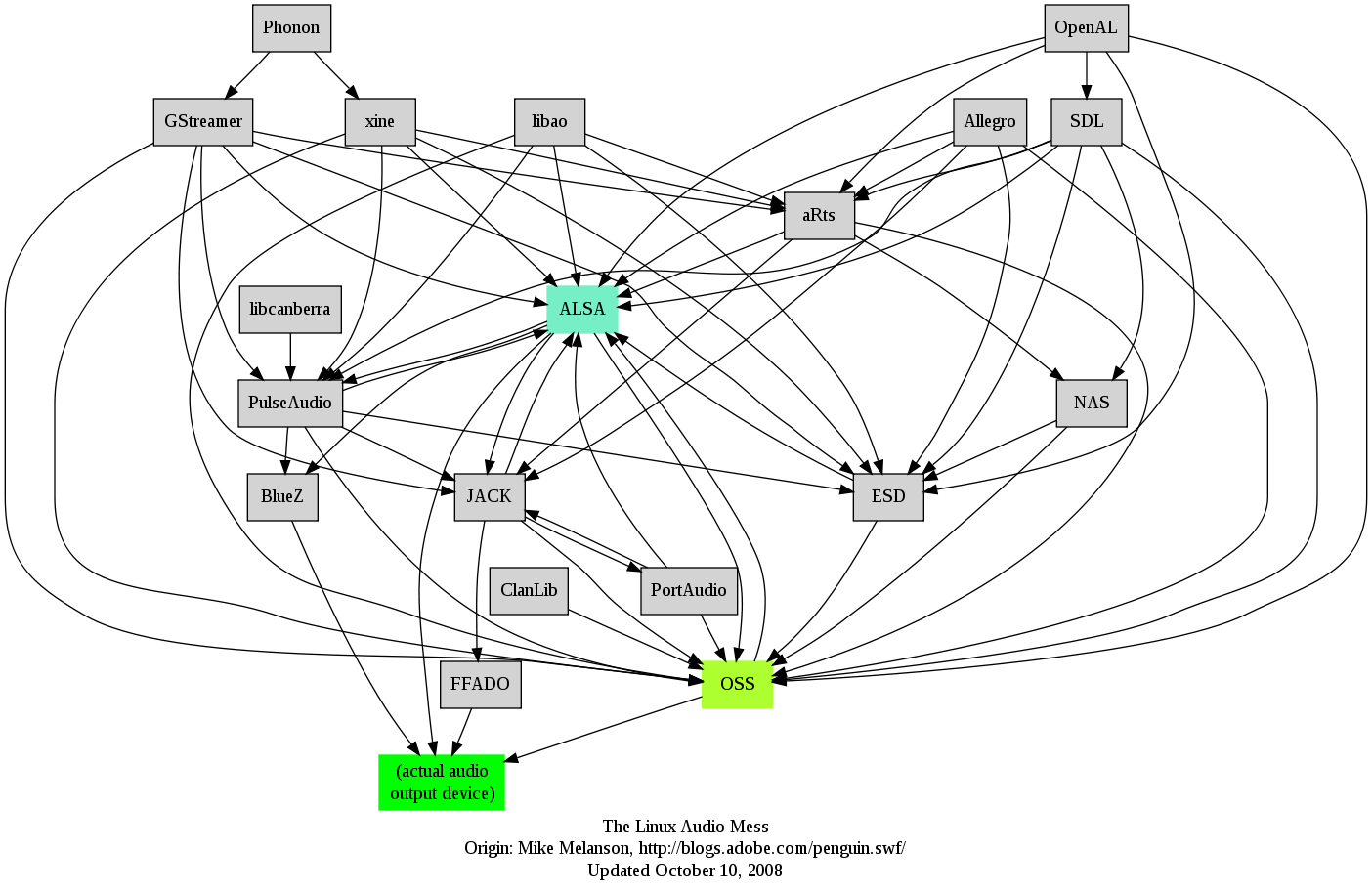
- Whenever someone mentions Linux and Audio I always remember this image (made by Adobe I think) https://harmful.cat-v.org/software/operating-systems/linux/a.... It is missing Pipewire but it should be easy to add a dozen of new lines. This is the reason why I simply use plain ALSA without any sound daemons.