Preferences

drmpeg
Joined 1,677 karma

  1. Here's some captures from my Comcast system here in Silicon Valley.

    https://www.w6rz.net/528x480.ts

    https://www.w6rz.net/528x480sp.ts

  2. > Videos with non-square pixels are pretty rare...

    Before HD, almost all video was non-square pixels. DVD is 720x480. SD channels on cable TV systems are 528x480.

  3. There's some thought that Ukraine could become a tech hub after the war due to their drone technology.
  4. Here's my ATSC 3.0 transmitter in C++.

    https://github.com/drmpeg/gr-atsc3

  5. Here's the Emmy that C-Cube Microsystems won back in 1995 for the MPEG-2 (actually unconstrained MPEG-1) encoder chip set used in the roll-out of DirecTV.

    https://www.w6rz.net/DCP_1235.JPG

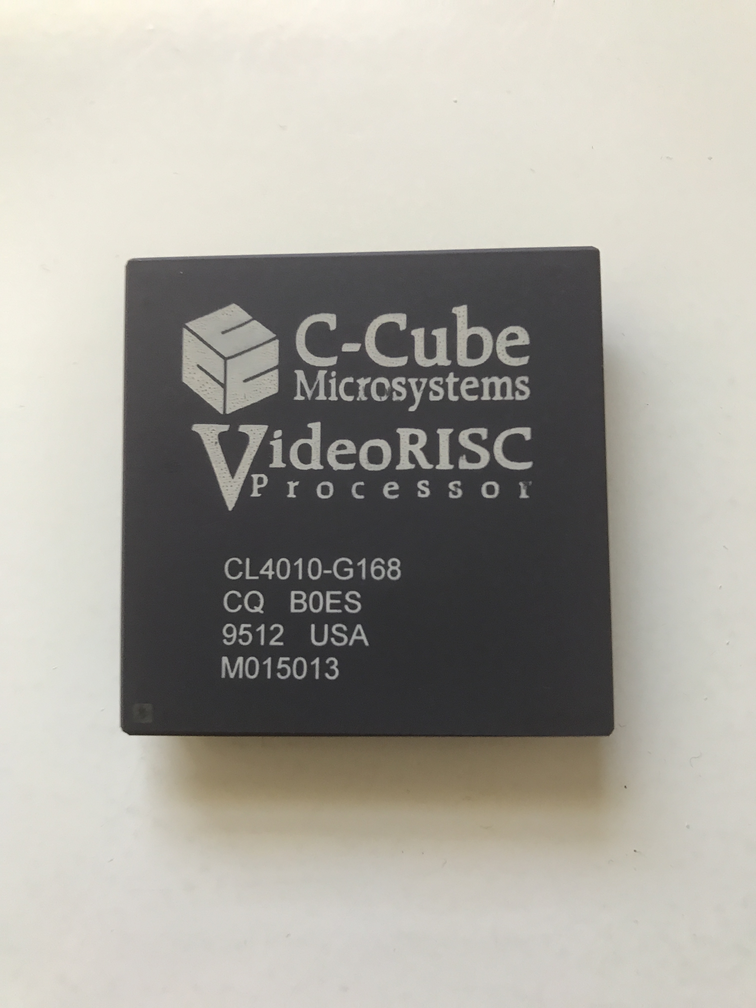
    The original DirecTV encoder was MPEG-1 at 704x480 using eight CL4000 chips. Then in 1995 when the MPEG-2 capable CL4010 was finished, the encoders were upgraded to MPEG-2 (frame only encoding). Then upgraded again to a 12 chip AFF (Adaptive Field/Frame) encoder when the firmware was completed.

    https://www.w6rz.net/videorisc.png

  6. I believe he's using a 6m antenna at the Allen Telescope Array (ATA).
  7. The first 16:9 content I ever saw was the trailer to "Batman Forever" (with Val Kilmer) in 1995 when I was working at C-Cube Microsystems. The studios use to send them test content all the time for video compression testing. It was on D1 tape, and looked beautiful for SD resolution. The professional Sony CRT 4:3 monitors back then had a 16:9 button to letterbox the image.
  8. Yes, you have it correct.

    However, predicting the effects of solar flares is very difficult. Not only does the particle stream have to hit the Earth, it has to couple with the magnetic field.

    Large flares can cause small events on Earth and vice versa.

  9. A severe geomagnetic storm is starting now (November 12 0000Z). But it's from the previous X-flares (X1.7 and X1.2), not the X5.1 flare.
  10. A lightly coded (13/15 LDPC) 256QAM OFDM signal at 40 MHz wide could do 250 Mbps.

    Or 31.25 million bytes per second if you prefer.

    This would be for a point to point terrestrial link. OFDM probably wouldn't work for EME (at any power level).

  11. Will you have arrays with the opposite antenna polarity for point to point links? That is, LHCP (Tx), RHCP (Rx) instead of RHCP (Tx), LHCP (Rx).
  12. It's theoretically possible.

    63.1 dbW = 93.1 dBm (240 watts + 39.3 dB gain)

    path loss at 5760 MHz = 283.2 dB (at perigee)

    RX gain = 39.3 dB

    93.1 - 283.2 + 39.3 = -150.8 dBm

    Noise floor at 1.2 dB noise figure and 500 Hz bandwidth = -151.9 dBm

    SNR = +1.1 dB (easily detectable by ear with CW).

  13. When I worked at LSI Logic in the 2000's, there were a lot of young Europeans (mostly Italian) on the staff. They had rented a house in Palo Alto which was affectionately called "The Pleasure Lounge".

    It was just one of those houses that had the awesome party vibe. The only rule was that if you had to puke, you had to go in the back yard and do it in front of the Mother of Mary statue.

    The best part was if you made it to 4 am, the Italians would break out the spaghetti, cook a big pot of it and serve it with just olive oil (no tomato sauce). Sitting around the kitchen table wicked hammered eating plain spaghetti is the correct way to end a party.

  14. I got to go inside Cheyenne Mountain Complex back in 1988 when I was the project engineer for the DSP satellite ground network upgrade. Unfortunately, I didn't get to see any control room. In fact, I didn't get to see much at all. When we got there we were informed that the problem had already been resolved, so we just turned around and left.

    But I did get to go down the tunnel and through the blast door.

  15. Here's a video of AM modulation. SDR transmitter (running GNU Radio) connected to an SDR receiver.

    https://www.youtube.com/watch?v=9LsJn0CyyZI

  16. Cool. We had a small company in San Diego called Metacomp (long gone now) design a Z8530 add on module for their 80186 based Multibus board. It had two Z8530 chips on it and you could have two modules on the base board. So 8 channels total per slot.
  17. Multi-link HDLC. That brings me back to 1985 and the Intel 8274, Zilog Z8530 and the Western Digital WD2511 (that implemented the layer 2 protocol in silicon).
  18. Same experience here with hospital pagers. I tried this way back in 2013 when I first started with SDR. Even without covid, the messages were hideous and depressing. Not recommended.
  19. Here's some "glitch art" made with an SDR transmitter output power set to exactly the SNR threshold of the receiver.

    https://www.w6rz.net/pixellation.mp4

  20. It's going from the frequency domain (parallel symbol streams) to the time domain (multi-carrier RF), so it's using the inverse FFT.
  21. I've never bothered listening to music while coding. If I'm in the zone, it's entirely extraneous and I don't even hear it.

    At my first job in Silicon Valley, I used to code right on the production floor totally oblivious to what was going on.

  22. This is pretty pedantic, but allocated radio frequencies start at 8.3 kHz.

    https://www.fcc.gov/sites/default/files/fcctable.pdf

  23. Yes, this is what makes moon bounce (EME) attainable. The gain of the moon is about 142 dB at 1296 MHz.
  24. $30,000 SDR wasn't good enough. Zoinks!

This user hasn’t submitted anything.

Keyboard Shortcuts

Story Lists

j
Next story
k
Previous story
Shift+j
Last story
Shift+k
First story
o Enter
Go to story URL
c
Go to comments
u
Go to author

Navigation

Shift+t
Go to top stories
Shift+n
Go to new stories
Shift+b
Go to best stories
Shift+a
Go to Ask HN
Shift+s
Go to Show HN

Miscellaneous

?
Show this modal