1
point
Giho
Joined 31 karma
- "The enemy of efficiency
Many organizations are obsessed with efficiency. They want to be sure every resource is utilized to its fullest capacity and everyone is sprinting around every minute of the day doing something."“You’re efficient when you do something with minimum waste. And you’re effective when you’re doing the right something.”This is what's called productivity. Efficiency is how much the productivity align to a certain goal. Depending on which goal you measure the productivity against the efficiency will be different.
In the case of Tony "Every minute of his time goes on the most important part of his work—making decisions—and not on dealing with trivial inconveniences like waiting in line at the post office."
does he take the -right- decisions for the company benefit? Could he think up good strategies at the waiting line? or get inspiration from the surrounding? or just rest at the waiting line to perform better in action?
To make it more trivial: Imagine a worker that's really good at making shoes. This worker can output 60shoes a hour (with good quality). But now this worker actually works at company making computers. The computer company does not really now what to do with all these shoes. The worker is really good at making shoes and have high productivity compared to his fellow friends at a shoe company. But it does not help the computer company to sell or produce more computers. This shoe maker would probably be a better fit in a shoe company. (But who knows, maybe the shoes are so good that the fellow computer makers need less time at the doctor by wearing them. And them seeing the shoe maker creating shoes with such determination and productivity, that they get inspired to make computers with same determination and productivity.) Only the results can tell.
So what is the goal? That is probably the most difficult question. As to be able to measure efficiency the goal needs to be measurable. And probably there is not only one goal that a company strive for but many. And these goals can compete with each other. These goals can also be divided into smaller goals, for different parts of the organization.
Efficiency isn't so easy to measure but productivity is. Therefore most tend to stick with productivity as a tool to improve.
There's often a mix up with productivy and efficiency which makes the messages confusing.
A good read: M Goldratt, E. and Cox, J., 1993. The goal - A process of ongoing improvement.
- There is a todo format that I use daily called todotxt. It has even application support on most platforms or you just write manually in a txt file. Easy to overview by yourself. In combination with Syncthing I have a very seamless experience where ever I go.
- What many seem to use as argument for wind, solar, hydro and geothermal is its price. But to compare the price with nuclear is flawed. The price of wind, solar, hydro or geothermal doesn't include the price of planability. Wind and solar would need some sort of energy storage to produce continuous energy. Hydro and geothermal only works at places where it can be installed. A good example for need of planability can be submarines or spacecrafts. Many of these crafts use either fossil fuels or nuclear as main energy source. Stop compare apples and oranges, they have different use for different cases.
- > It's really not a priority above money, though. Money isn't some magical evil thing. Money is the unit of account that we use to measure goods and services.
Money is not magical but they may conceal the truth as the rabbit in a hat. Money is numbers and with numbers you can do math, its easy to grasp. But money doesn't in itself explain the factors around. A product or service may have a certain cost because of the quality or because it's subsidized or because its valued different or because of another unaccounted factor. And what if its something that is invaluable? No money in the world can be fixed to it. The risk of letting money be the priority is that we may see the number but not the damage to the nature behind it. As climate change probably will take lives or even humanity in the future and life has one of the highest value, or at least the life of oneself, therefore it is a priority above money.
> Something "costing money" means that it reduces the amount of goods and services we can create. Climate change "costs money" in the sense that it reduces global output. Reducing global output has a human cost, especially for low income nations.
And if it's so then what says the cost needs to be distributed evenly? Around 5% of the world population hold 70% of the world wealth(at least 2012).
> To you and I perhaps it is 'just money' because your standard of living is sufficiently high that a 10%, 20% or even 50% reduction is a sacrifice of comfort, and not existential. But contracting the growth prospects for India by 25% over the next decade means consigning millions of people to crippling poverty. > This idea that money is some morally lesser concern just fundamentally misunderstands what money is. Aggregate wealth is just all the stuff we have. Less money means less stuff. Less stuff means more poverty. That may be worth while, if we think climate change is severe. But it's always extremely important to keep this in perspective. > Climate change is primarily going to hurt the world's poor, and so are the cuts we'll have to make to combat it. But if you don't keep that in perspective, the cure may end up worse than the disease.
If we would divide the aggregated wealth equally between all people then the standard of living would probably be pretty decent and economical growth wouldn't be necessary. Thou I find it hard to imagine that ever happening. The difficulty for people to work without incentives. The difficulty for people to realise it's just not their hard work but mostly luck that brought their wealth.
Climate change hopefully will change peoples views and values. If we won't find a cure we may at least embrace the disease.
- The article start with the example of to cleaners that takes a break at their job and that is seen as inefficient in today's society. But I say this is most a misuse of the word and understanding of efficiency. Taking a break is a stop in productivity short term(cleaning in this example). Efficiency can actually be better by a break, by boosting productivity long term and thus reaching the goal (clean streets) with higher quality. Most management try to think scenarios in closed simplified systems with in- and outputs at a certain time, but by doing this the bigger picture is missed. For example: By neglecting the cleaners wellbeing (physically and mentally) the output may be good cleaning for a while but as times go with no break the wellbeing decrease and so the output.
- I think this is an important point. How is the data processed, given and saved? -Are the movements and start to stop positions saved when doing the strokes? -Or is a picture taken after the stroke is released and the pixels compared one by one? - is it made to vector art and then compared? -or just take mouse input, button pressed and not in a time log sort of and compare?
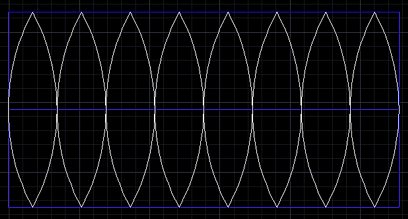
- I don't understand how they do the comparison between the torus and sphere. First to take a rectangular paper as an example for a torus and then say some parts would stretch doesn't make a scientific comparison to a sphere. As I understand the only difference between a sphere and a torus geometrical is that as a flat piece the sharp tops are cut of a flat piece of sphere. See link for picture of flat sphere: https://www.cadforum.cz/img/petals.gif
- I don't understand your criticism thou. Netflix already had 167M paying subscribers in the final quarter of 2019 increasing roughly by 10-20M subscribers each year, so they will probably be up to 220M in year 2023-2024. They are soon there and still have debt. And 220M times $11, I only get to 2.4B, then you also have account for the expenses before you can call it a revenue. As I understand Netflix has a debt of roughly 12B and their operating expenses for 2019 was roughly 17B, so that's also why Netflix need to lend, can easily escalate. I can understand the fear from investor's.
- That makes me think of Braess paradox and see parallels. (https://en.m.wikipedia.org/wiki/Braess's_paradox) As most people seem to try to take the most optimal self-interested decision it does not always make the outcome the most optimal for them or everyone. As actions we take as not, affect more than ourselves and can't be totally disconnected from this world.
And as a individual to be able to take the most optimal decision in complex systems is pretty difficult. What would we be without our choice and an AI or a higher power would take the decisions for us?
- From article: "But, Ramirez-Valles says, the study does a good job of showing that when it comes to health outcomes, "it's not always [immediately] about health." He says the study's findings indicate a need for two broad policy recommendations: a revision of the minimum wage and a rethinking of our current taxation system.
"Income inequality is at the bottom of this," he says. "We need to target and attack [it] aggressively. Not only in this country, but worldwide." "
When I read this I think of Thomas Pikettys research. https://en.m.wikipedia.org/wiki/Capital_in_the_Twenty-First_...
This concentration of wealth haven't happened over a night. I don't think the income difference is the only problem but also the accumulation of capital. The article seem to forget the difference between income versus spending in addition to start capital.
How is the health of people with a lot of capital and a low income and high spending? Or is it not possible to have low income with a lot of capital?
The rethinking of the taxation system, I do think Ramez has a point as income has higher taxation compared to capital. The amount of capital matters more than the amount of income.
- I'm sad for their misfortune but arguing against nuclear won't do any good for them, on contrary as this article states nuclear is safer than the other major energy sources. A family is a small sample size too. Of course we should also look into other studies of the energy sources total effect on humanity, to be sure. I think we have to see the big picture and not focus on our bubble.
I see an analogy to car and plane safety when comparing coal and nuclear safety. Car accidents are more frequent and damage can vary, while plane accidents are seldom but often severe. It is difficult to foresee the future, but we have the past that give us a good indicator of what will save most lives.
- Why don't they make a review system where the products with fewest bad reviews gets rated the best.
If the reviews have to go through Amazon's system it should be hard enough to fake. The "true" customers will make bad reviews if they didn't like the product. The "fake" reviewer can't rate their own products to make them get a better review, an they have to buy the competitors product x times to give x bad reviews.
- Could instead of having pro and con people write their argument for the question without putting it as pro or con. Then people can vote where they value the argument morally or for other reason on a 10 scale or something like that. Example: Issue - WiFi should be controlled fully by the WiFi alliance(something like that) Argument - WiFi use unlicensed spectrum (This could be seen both as positive and negative)
So then people vote if they think its more positive or negative by rating it from pro to con on a 10 scale. But if there are sub arguments to the arguments the voting of the sub arguments affect the value of the argument. Sub argument - non-licensed WiFi create a market for cheap electronic equipment connected to the cloud(iot). (Could also been seen as pro or con.) And so on.
Maybe bad example, but if a argument should support a thesis or not, I think is good to put in the hands of the peolpe with their values instead by the writer of the argument. And as all is not is not black and white a 10 scale (something similar)could make it more colourful and maybe more accurate to what people think.
The rocket was cruel and demanded more fuel.
A tree wished to grow, but alas, too slow; in exchange for a tan, the sun gave what it can.
The sun reached its goal — with its new friend, coal.