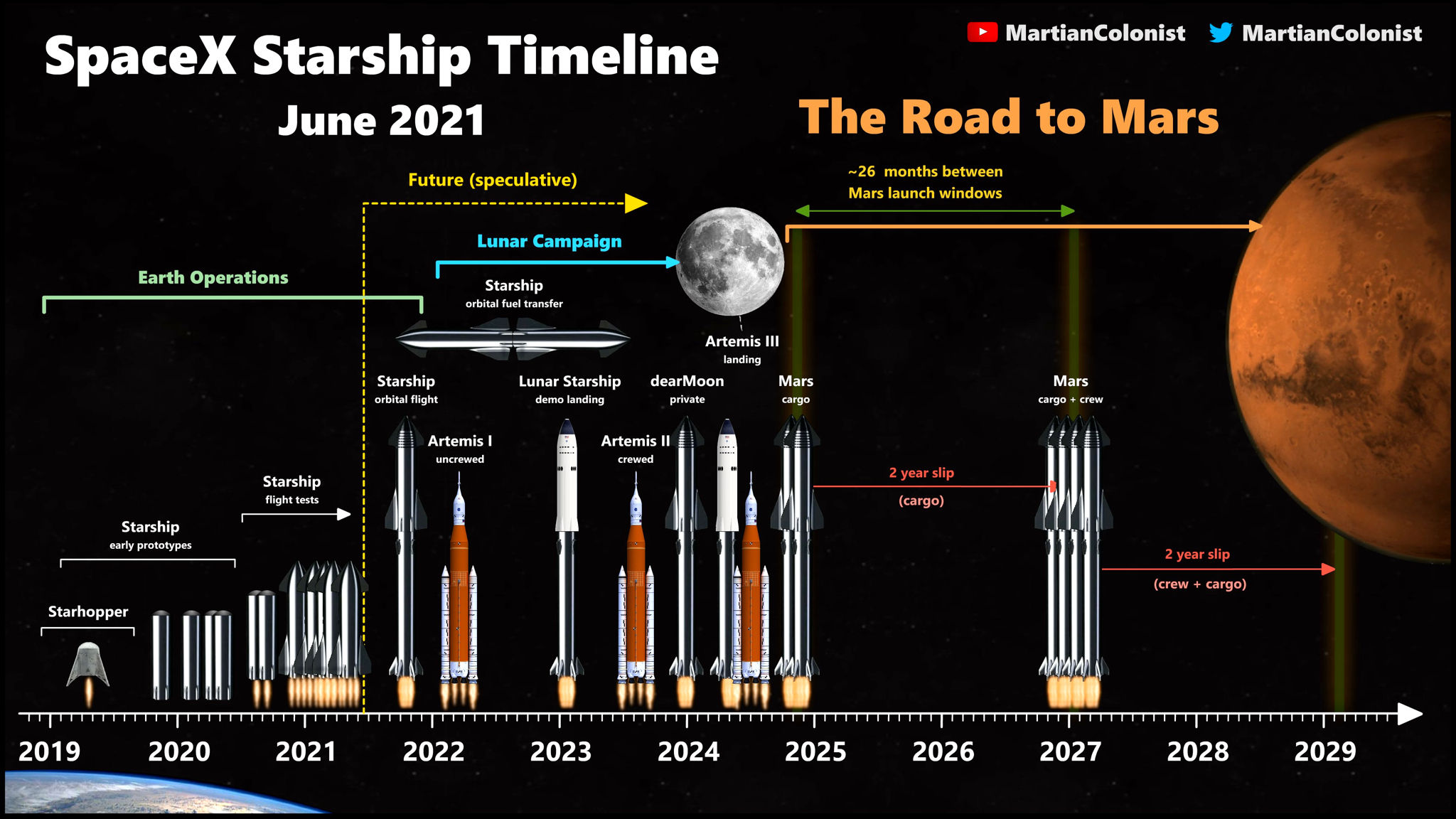
The GAO put out a report on this a few months ago, pointing out the failures of SpaceX here (including massive cost overruns) much more than the supposed cost overruns of SLS. Incidentally, after this GAO report came out, Elon Musk became very interested in being in charge of managing "government waste."
Orion is delayed due to a heat shield issue: https://www.nasa.gov/missions/artemis/nasa-identifies-cause-...
The first SLS launch was six years behind and massively over budget.
Lunar Gateway is almost certainly getting delayed.
None of these programs rely on SpaceX in any way thus far.
There is an issue with another dependency for Artemis 2 and 3, though - Starship is nowhere near where it needs to be.
Artemis II has no Starship dependency. It's entirely SLS/Orion.
Your own article agrees with me:
> Artemis 2 likely would've been delayed by a year or so, to late 2026, had a heat-shield replacement been required, NASA officials said today. But the mission team still needs more time than originally envisioned to get Orion up to crew-carrying speed, explaining the roughly six-month push.
> "The heat shield was installed in June 2023, and the root cause investigation took place in parallel to other assembly and testing activities to preserve as much schedule as possible."
And of course its completely ridiculous to blame a program that received 2 billion $ and only really started a few years ago, vs things like SLS Orion that have been going for decades and absorbed 50 billion $.
And I'm not so sure that they actually decreased price to launch all that much. First of all, it's definitely not "several orders of magnitude", the best numbers quoted are maybe half price or so for a Falcon 9 compared to another contemporary rocket. And by my understanding, the US government at least is paying about as much for Falcon 9 as it was for a Soyuz to bring an astronaut to the ISS, at least.
So, NASA today is paying Boeing more than the monopoly prices Russia charged (up to 2016 or so), and paying both of them more than Russia was charging back when they were competing with the Space Shuttle. And it's paying SpaceX about half of the top price it payed Russia per seat, still nowhere close to an order of magnitude in cost savings.
[0] https://www.businessinsider.com/astronaut-cost-per-soyuz-sea...
[1] https://www.reuters.com/science/boeing-sending-first-astrona...
I remember the talk of broomsticks and trampolines.
The price savings are clearly evident per that article.
The only reason Boeing ended up charging that much is the extra money NASA gave them.
It wasn't so from the beginning
How would I distinquish between the two, esp wrt rocketry?
An engineering achievement means excellence in designing a new vehicle, or updating an existing one, or inventing a new procedure, and finding the right tolerances that allow that to be replicated over and over without excess cost.
So using some wholly new process, like the continuous innovation involved in casting large parts, how would I separate ops and engr?
Forgive my ignorance. I'm just wondering how Ford's quality circles, or the Toyota Production System would work if ops and engr were treated aa separate silos.
Since we're kibitzing about rockets, I suppose the example above could have been ramping up production of Raptor engines to 1 per day (IIRC), while improving performance and reducing costs. If I wanted to emulate that process, using your methodology, where would I start?
The reusability is awesome, of course. More of that!
And also, still gotta get the basics right. Oxygen/fuel leaks aren't a great look (spoken as a not rocket scientist).