I love analogies between fields like this.
Water flows in pipes, valves, etc. concepts transfer to a lot of basic electrical circuits and concepts. E.g. voltage is analogous to pressure. Current is analogous to the volume of water flowing. Bigger pipe (wire) can carry more current. Valves are like switches or resistors. It works to de-mystify concepts for kids who have no concept of what electricity is but can think about water flowing in a pipe.
The base analogy working is cool but that other mechanisms on top also work similarly is what amazes me.
Circuitry (both digital and analog, including entire computers) can be built using hydraulics. Complex parts like logic gates, oscillators are present, but also "passive" things like accumulators, resistors, and valves -- it's all there.
They work in about the same way as electronic circuits do.
(But it's almost always less expensive to push electricity around than it is to push liquid around, and the parts are a lot smaller, so obviously electronic circuits are the usual winner.
Nonetheless, hydraulic circuits are still pretty common: See, for example, the valve body of an automatic transmission such as (mostly?) electronics-free 700R4.)
Coming from an EE background and doing some simple hydraulics work, it blew my mind that the various components are mainly just the right shapes of metal. In retrospect I don't know what else I could have been expecting, except that electronic components are generally made of some special substance. Talk about actual "bare metal" development.
Also the signal propagation speed in a fluid system is limited to the speed of sound in that fluid, vs ~c in electric circuits
There are limits to the propagation velocity of signals in both systems that are sometimes necessary to account for. Hydraulics tend to be slower, but it's still the same problem -- each just has different values to plug in and deal with.
Concerns about things like impedance matching and reflections are also the same.
And so on, and so forth.
Circuits are circuits.
There is a whole area of multi-domain simulation, where the simulator seamlessly jumps from one form of energy to another as long as the units match. I have always loved that.
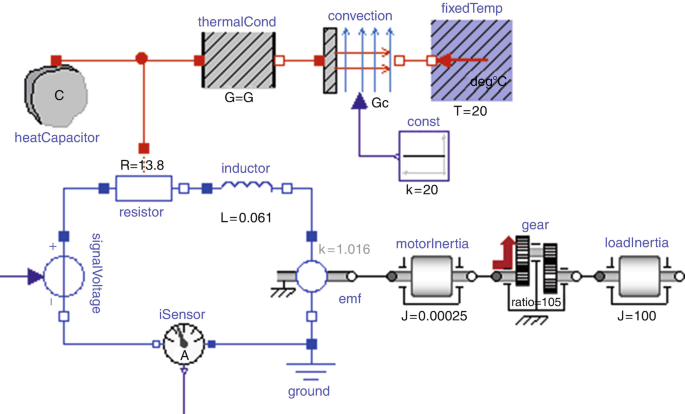
oh nice
Current is analogous to momentum, because electron drift has net momentum.
The equations for the two devices are essentially the same, only the units change.
1 https://en.wikipedia.org/wiki/Hydraulic_ram